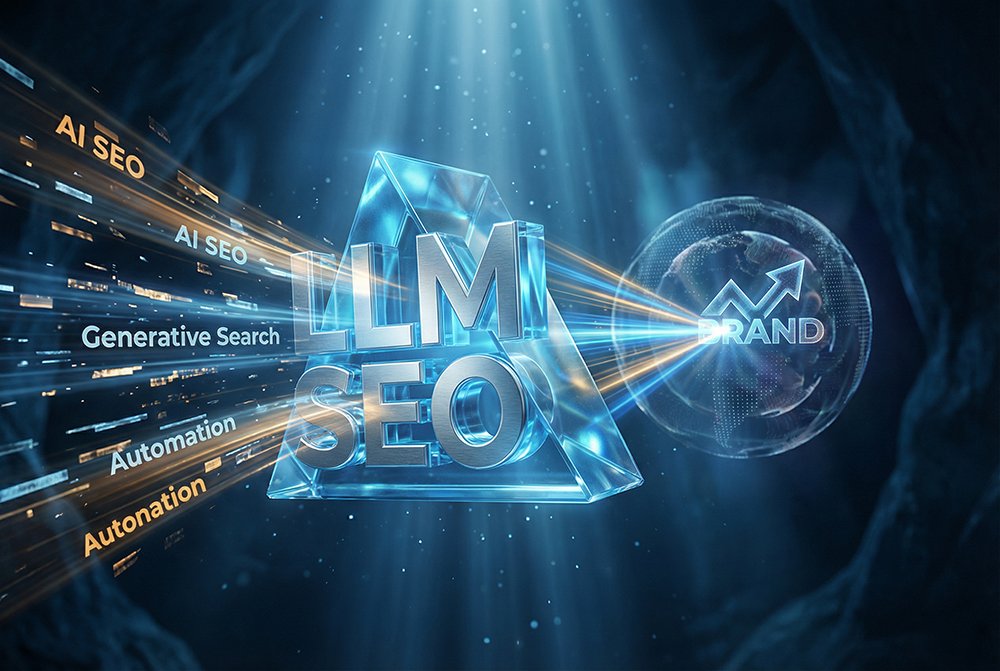
The shift has been seismic, yet it happened so quietly that many brand managers missed the tremors entirely. For two decades, the internet operated on a simple, predictable contract: a user types a query into a search box, and the search engine returns ten blue links. The job of a marketer was clear—engineer your way into those ten blue links by any ethical means necessary. That world is now a fading photograph. We are standing in the middle of a new landscape, one constructed not of hyperlinks but of paragraphs, not of indexed pages but of probabilistic language models. This new landscape demands a new kind of optimization, one that feels less like engineering and more like reputation cultivation. It is called LLM SEO, and understanding its interior mechanics is no longer a competitive advantage; it is a survival imperative.
The anxiety in boardrooms is palpable. A chief marketing officer of a major e-commerce platform recently confessed that her team’s panic began the day they asked a popular AI chat interface for “the best running shoes for flat feet” and saw their top competitor mentioned while their own brand, which holds the number one organic spot on a traditional search engine, was completely absent. The brand was not just losing a ranking; it was being erased from the narrative. This is the core terror and the core opportunity of the generative search era. The mechanism of selection has changed. We are no longer optimizing for an algorithm that crawls pages; we are optimizing for a machine that reads, understands, and synthesizes opinions. To thrive, one must go deep inside the logic of Large Language Models and rebuild the concept of visibility from the ground up.
The Collapse of the 10-Blue-Link Economy
To understand where we are going, we must mourn what we are losing, not out of nostalgia but out of strategic clarity. The traditional search engine optimization industry was built on the physics of the hyperlink. Google’s PageRank algorithm famously treated a link from one site to another as a vote of confidence. The entire economy of digital marketing—content farms, guest posting, link exchanges, and domain authority metrics—sprouted from this single, elegant idea. It was a quantitative game. You could measure your domain rating, track your keyword positions with pinpoint accuracy, and calculate the exact traffic potential of a first-page ranking using a formula that multiplied search volume by click-through rate.
This paradigm created a very specific kind of web. It gave us the long-form, bullet-pointed, “best-running-shoes” articles that aimed to satisfy an algorithm’s checklist of relevance. It gave us the tyranny of the specific keyword phrase. Marketers sliced and diced language into little granular units, targeting the exact string of words users typed into a bar. This was a world of high control and high predictability. A brand could, with enough budget and expertise, effectively purchase visibility by dominating the algorithmic criteria.
Large Language Models (LLMs) have broken this model entirely. When a user asks an AI interface a complex question—”I’m planning a trip to Japan in the autumn with two young children who are picky eaters; suggest a ten-day itinerary that balances cultural sites with fun activities for them”—they are not entering a keyword. They are engaging in a dialogue. The AI does not simply look for a page that matches the terms “Japan,” “autumn,” and “picky eaters.” It constructs a wholly original answer by aggregating and synthesizing information from thousands of sources in its training data and real-time retrieval index. There is no single page to optimize. The “result” is an act of creation. This represents a fundamental shift from a retrieval model to a generation model. In a retrieval model, the search engine is a librarian pointing you to the bookshelf. In a generation model, the AI is the library itself, writing you a new essay based on its reading of every book in the building. Your brand’s goal is no longer to be the most prominent book on the shelf; it is to be the primary source the librarian remembers and trusts when it’s time to write that essay.
The Cognitive Architecture of an LLM: A New Kind of Index
To practice LLM SEO effectively, one must abandon the mechanics-first mindset of traditional search and adopt a cognitive-first approach. How does a large language model “know” things? It does not know in the human sense; it predicts. An LLM is, at its core, a next-word prediction engine of staggering complexity. Trained on a massive corpus of public text—books, articles, code, forums, and transcripts—it builds a multidimensional map of semantic relationships. In this map, the concept of a “leading athletic footwear company” exists not as a dictionary definition but as a constellation of weighted associations: innovation, specific athlete endorsements, product technologies like foam compounds, and cultural moments. When a user’s prompt activates a part of this semantic space, the model navigates these associations to construct its response.
This is the first crucial insight for the brand optimizer: you are not trying to rank for a keyword; you are trying to become a robust node in the model’s semantic network for a given topic. Visibility in a generated answer is a function of associative strength and contextual relevance. The question then becomes: What data creates the strongest associations? The answer is a diverse, consistent, and deeply authoritative digital footprint. The model’s “memory” is a foggy imprint of its training data. A brand that appears consistently across high-quality, thematically relevant datasets—from academic papers and news articles to product reviews and expert blog posts—becomes geometrically linked to the core concepts of its industry. It is the difference between being a single data point and being a statistical trend. The AI does not “choose” a brand because it has the highest domain authority; it generates the brand’s name because, in the probabilistic weightings of its neural network, that brand is the most probable token sequence to complete the thought about the category.
The introduction of Retrieval-Augmented Generation (RAG) adds another layer of complexity and immediacy. Most consumer AI chat interfaces now perform a live search to ground their answers in current information before generating a response. This is not a return to the ten blue links. The AI is still the final author. It issues a search query, reads the top results, and then synthesizes them into its own prose. This process, often invisible to the user, is where the old world and the new world collide. Your traditional search presence is not irrelevant; it is now the source material for the AI’s real-time research. A robust organic ranking is no longer a destination but a required credential. If your brand is not visible on the first page of a standard search for your core category terms, the AI performing RAG is highly unlikely to discover you, read about you, and therefore cite you. The old SEO is no longer the final product; it is the raw ingredient for the new.
A Strategy for Semantic Topography
How does a brand practically optimize for a system that is an author, not an indexer? The strategy must shift from keyword density to semantic topography. The goal is to map and dominate the entire conceptual territory around a subject, not just a handful of transactional keywords.
The foundational layer of this strategy is the creation of what can be termed “Entity-Authority Content.” An LLM understands the world through entities—people, places, things, ideas—and the relationships between them. Your content must explicitly and authoritatively define these relationships. A traditional product page might describe a “lightweight, waterproof trail running shoe.” An entity-optimized product page for LLM SEO would structure this information within a clear, descriptive framework, connecting the entity “Trail Runner X” to attributes like “Gore-Tex membrane,” “5mm heel-to-toe drop,” “Vibram Megagrip outsole,” and use-cases like “technical terrain in wet conditions.” The language is encyclopedic, precise, and descriptive, avoiding vague marketing jargon. The AI is not seduced by words like “revolutionary.” It is informed by words that connect your product to the specific, tangible features and problems it solves. This is the process of firmly planting your brand’s entities in the model’s knowledge graph so that when a user asks for a shoe for wet, technical terrain, the probabilistic path leads directly to your door.
This entity-centric approach must be amplified by a content ecosystem designed not just for humans but for AI ingestion. For years, we have talked about topical authority—building a comprehensive corpus of content on a subject. This concept is now more critical than ever. The AI is writing its essays based on its entire understanding of a field. A brand that has published a single, thin article on “sustainable packaging” will be a whisper in the model’s mind. The brand that has published a definitive guide to the history, materials science, regulatory landscape, and economic impact of sustainable packaging will be a loud, clear voice. This requires a deliberate publishing strategy that builds dense content clusters. A central pillar page provides a high-level overview, but it is supported by dozens of deep-dive articles that explore every nuance of the topic, each one meticulously citing primary sources, research, and expert interviews. This web of interlinked, authoritative content creates a semantic gravity well. When the AI “thinks” about the topic, it is pulled unavoidably into this dense cluster of information, absorbing your brand’s perspective and terminology as the de facto standard.
The final and most nuanced pillar of this strategy is the cultivation of a brand’s co-occurrence footprint in the training data. An LLM learns associations not just from what a brand says about itself but from the context in which it is discussed across the entire internet. This is the new, more profound form of digital public relations. The goal is for your brand to be mentioned in the same breath as the leaders, trends, and problems of your industry. This means securing deep, integrated features in respected publications, not with a transactional backlink for PageRank, but with a qualitative mention that positions the brand within the industry’s narrative. It means having your executives and experts quoted in articles about the future of the sector. It means your research and data being cited in academic and industry whitepapers. Every time a journalist writes, “Companies like [Your Brand], [Competitor A], and [Industry Leader B] are solving this problem by…”, a powerful semantic bond is forged in the model’s training data. The model begins to categorize you not as an individual entity screaming into the void but as a recognized member of the core set of players who define a category. This is the modern equivalent of building a reputation, not just a backlink profile.
The Intractable Problem of Measurement
We now arrive at the deepest chasm in the LLM SEO landscape: measurement. The old paradigm offered a reassuringly complete data set. A dashboard showed keyword rankings, search volume, organic traffic, and conversions. The path from effort to outcome was, if not always straight, at least visible. The generative search environment is a black box. A brand mention inside a ChatGPT or Bard response is an ephemeral event, generated on the fly, often unique to a single user session, and buried inside a chat interface that provides no traffic data. This has plunged the marketing profession into an analytics crisis. How do you justify the budget for a visibility you cannot count?
The initial answer is a hard shift from traffic-based metrics to impression-based metrics, even if those impressions must be inferred. Brands must aggressively invest in third-party monitoring tools that are emerging to map this new terrain. These platforms use armies of bots to ask AI interfaces thousands of pre-defined questions every day, meticulously recording the responses and analyzing them for brand mentions, sentiment, and competitive positioning. The output is a new kind of dashboard, one that shows your “Share of Model Voice” for a given topic. A report might reveal that for questions about “eco-friendly logistics solutions,” your brand is mentioned in 45% of generated responses, while your main rival appears in 60%. This is a sobering but essential metric. It translates the fog of AI into a scoreboard. Your goal is to move this share by expanding your semantic footprint. It is a paradigm of share of mind, not share of click.
The second, more technically demanding measurement strategy is to build your own brand-tracking engine for RAG sources. Since AI interfaces often source their real-time information from a standard search engine’s index, you can reverse-engineer the AI’s reading list. For a given topic you are targeting, you must identify the set of 10 to 20 URLs that consistently rank highly on a traditional search engine for the key concepts. This becomes your “AI Source Corpus.” You then monitor your brand’s presence within this specific corpus. The logic is simple but powerful: if you are a dominant voice on the pages the AI is most likely to read during its RAG process, your inclusion in the final generated answer becomes a statistical near-certainty. Your measurement focus narrows from the chaotic, unbounded web to a tightly controlled list of 20 key pages. If your share of voice within that micro-corpus is high, your LLM SEO health is strong, even if you cannot track the downstream citation directly. You are optimizing the input to control the output.
The ultimate, and still largely aspirational, form of measurement lies in econometric modeling. This involves stepping back from the direct, traceable click and looking at the macroeconomic data for your brand. By plotting a timeline of your investment in entity-authoritative content and co-occurrence PR, and overlaying it with curves of branded search volume, direct traffic, and overall organic visibility, you can begin to identify the non-attributable “halo effect” of LLM presence. A user reads your brand’s name in an AI-generated guide to complex tax software. They do not click a link, but the name lodges in their mind. Two weeks later, facing a tax problem, they open a new tab and search for your brand name directly. Your analytics attribute that conversion to branded organic search, a channel you had already “won.” But the real marketing victory happened in the silent, unmeasurable moment of AI-assisted learning. The only way to see this is to look at the aggregate. As your team publishes a landmark research report that gets widely cited, you should observe a correlated lift in branded search volume, even if the report itself drives no direct traffic. This holistic, top-down view is the purest measure of success in the LLM SEO era, tying intangible mindshare to tangible business outcomes.
The New Organizational Competency: Prompt Flow Psychology
The technical strategy of LLM SEO cannot be fully realized without a deep, almost anthropological understanding of how humans interact with generative AI. The keyword was a blunt instrument. The prompt is a fluid, multifaceted expression of intent. A brand that optimizes only for its own name or its most obvious product term is thinking with a pre-2023 mind. The real visibility is found in the long, messy, conversational middle, where users articulate their needs in plain, complex language.
Consider the prompt: “I’m frustrated with my project management software; the reporting is too clunky and I can’t get a clear view of resource allocation without doing manual work in spreadsheets. What’s a better alternative for a 50-person agency?” This is not a search for “best project management software.” It is a narrative of pain, a description of a specific use case, and a clear articulation of a buying signal. Traditional keyword-based optimization would never capture this. LLM SEO demands that you map these cognitive journeys. You must build prompt libraries that catalog the hundreds of ways users in your target market express their problems, goals, and criteria. Your content strategy is then reverse-engineered from these prompts. You don’t write an article about “top CRM features.” You build an in-depth resource titled, “A Guide to Replacing a Legacy CRM When Your Sales Team Refuses to Log Activity,” because you know a frustrated VP of Sales will type a prompt very close to that.
This leads to the most counter-intuitive but powerful optimization tactic: training the user. A brand that invests heavily in LLM SEO for its own benefit has a parallel interest in teaching its potential customers how to be more effective prompters. A sophisticated AI user knows that a generic query yields a generic answer, while a specific, constrained query yields a precise and authoritative one. By publishing content that helps your audience become better at using AI—guides on advanced prompting techniques for your industry, for example—you achieve a strategic lock-in. A user who has learned from your guide that they should ask the AI to “only recommend solutions that are SOC 2 Type II compliant, integrate with a specific accounting tool via native API, and have a track record of deployment in mid-market financial services” has just constructed a filter that likely only your brand can pass through. You have moved beyond optimizing for the answer and have begun to optimize the question itself. This is the apex of LLM SEO strategy: the elegant shaping of the demand signal before it even reaches the model.
The Moat of Unreplicable Authenticity
As we race toward a hyper-optimized future, a terrifying thought crystallizes: if everyone optimizes for the AI, the AI’s training data becomes a hall of mirrors, reflecting only the SEO strategies of every brand, creating a homogenized, useless sludge. The ultimate defense against this, and the ultimate performance-enhancing substance for LLM SEO, is something the model cannot generate from patterns: authentic, proprietary truth. The AI can remix public information with dazzling speed, but it cannot conduct a live scientific experiment. It cannot sit in the field with a customer. It cannot generate a unique, forward-looking thesis based on the private, messy, human experience of running a business.
This is where the final, and most durable, form of LLM SEO takes root. It is the strategy of generating primary data. A brand’s visibility inside a model’s knowledge graph becomes exponentially “sticky” when that brand is the primary, and perhaps only, source of a vital piece of information. A property development company that publishes a quarterly, proprietary index of construction material costs, based on its own aggregated, anonymized purchasing data, is creating a singular asset. No AI can synthesize this from public sources, because it does not exist elsewhere. Suddenly, every discussion about construction inflation in an AI interface must, in a probabilistic sense, reference this company’s index. The brand has become a primary node in the world’s understanding of that topic. This is the content moat that no competitor’s prompt injection can easily cross. The strategy extends to any form of proprietary insight: a unique methodology, a contrarian perspective grounded in decades of hands-on experience, or a data-driven trend report. The objective is to produce output that is not just great content but raw material for the world’s intellectual processing. You are feeding the model a new fact, and in doing so, you become inextricably linked to the factual landscape of that topic.
In the end, the interior logic of LLM SEO reveals a profound and somewhat comforting truth. The age of the mechanical algorithm rewarded a cold, scalable, and often dehumanized approach to content. The age of the generative model, ironically, rewards something much closer to a human concept of trust. An LLM’s neural network, in its probabilistic fog, builds a representation of a brand based on a synthesis of all available public knowledge. This representation is not a ranking score; it is a reputation. And a reputation in this new world, much like in the old, is built not on a single, clever signal, but on a broad, deep, and consistent record of authentic contribution. The brands that will be spoken by the machines will be the brands that spoke with clarity, authority, and genuine value in the first place. The measurement may be harder, the mechanics more opaque, but the core principle is startlingly familiar: be the best answer, not just for an algorithm, but for the intelligence that is reading the internet and trying to understand it.