Topical Authority and Content Clusters: The SEO Strategy Actually Working in 2026
Google’s March 2026 Core Update shifted rankings for 55% of websites — and the pattern in who climbed and who fell was strikingly consistent: sites with genuinely comprehensive topic coverage moved up, while sites publishing scattered, thin content on the same keywords moved down.
Why the Old Playbook Stopped Working
The traditional approach — find a high-volume keyword, build one page around it, chase a few backlinks — still produces results in narrow circumstances, but it’s a genuinely weaker strategy than it used to be. According to Digital Applied’s 2026 breakdown of the shift, Google’s Helpful Content system now evaluates topical depth, E-E-A-T signals, and the structural coherence of a site’s internal link graph — three things a single isolated page simply can’t demonstrate on its own, no matter how well-optimized it is.
What a Content Cluster Actually Is
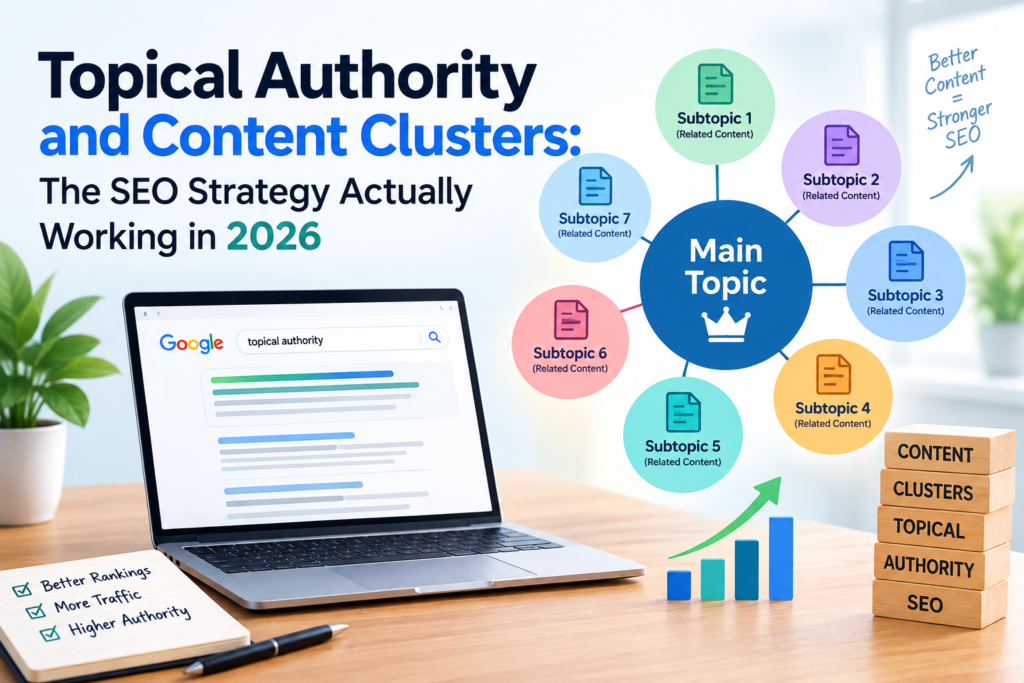
A content cluster is a structured network built around one pillar page — a comprehensive overview of a broad topic — supported by several cluster pages, each diving deep into a specific, well-defined subtopic or angle, all linking back to the pillar. The internal linking here isn’t decoration; it’s the entire mechanism that signals to Google your site genuinely covers the subject, rather than gaming one narrow keyword in isolation.
The Numbers That Make This Worth the Investment
According to Shortlist’s 2026 content strategy analysis, sites prioritizing topical authority first see ranking gains up to 3x faster than those chasing domain authority alone, based on a review of more than 400 SEO campaigns. The same analysis found sites implementing content clusters correctly saw an average 40% increase in organic traffic compared to non-clustered content strategies.
How Many Pages a Real Cluster Actually Needs
A commonly cited benchmark suggests 25 to 30 high-quality, genuinely interlinked articles within a single content cluster before investing heavily in link acquisition — a single exceptional article on a competitive keyword will consistently struggle against a competitor who’s published 15 or more interconnected pieces covering every meaningful angle of the same broader topic.
Why This Also Matters for AI Search, Not Just Google
According to Launchmind’s analysis of the GEO dimension, AI search engines like ChatGPT and Perplexity evaluate the collective credibility of an entire source, not just one individual article, when deciding whether to cite it in a generated answer — meaning topical authority increasingly determines AI-search visibility too, not just traditional blue-link rankings.
The Content Gap Analysis That Starts This Process
Rather than guessing which cluster pages to write, identifying the 10-15 real questions your target audience asks at every stage of their research or buying journey, then mapping which of those you currently answer well, answer poorly, or don’t address at all, gives you a genuine, prioritized roadmap for which cluster pages to actually build first.
Why Thin Cluster Pages Defeat the Whole Strategy
A cluster page that’s genuinely thin — 300 words repeating the pillar page’s points without adding real depth — doesn’t just fail to help; it can actively signal a lack of genuine expertise across the topic, undermining the exact authority signal the cluster structure is supposed to build. Every cluster page needs to answer a specific, well-defined question in real depth, not simply exist to pad out a page count.
Where Internal Linking Fits Into All of This
Internal links between cluster pages and the pillar aren’t optional polish — they’re the specific mechanism that passes topical relevance signals between pages and lets search engines actually map how your content relates. This same internal-linking discipline is exactly what we’ve covered in our technical SEO checklist for 2026, where crawlability and internal link structure are treated as foundational, not optional add-ons.
How to Actually Start Without Getting Overwhelmed
Rather than attempting 25-30 articles immediately, starting with one genuinely strong pillar page and three to five well-researched cluster pages, then expanding steadily, is a far more realistic path than treating this as an all-or-nothing commitment. Agencies managing [CLIENT LINK PLACEHOLDER] ongoing content strategy for clients increasingly build this cluster expansion into a standard monthly production schedule, rather than attempting to launch a complete cluster all at once.
Frequently Asked Questions
How long does it take to see ranking results from a content cluster strategy?
Meaningful results typically take three to six months of consistent publishing and internal linking, though some individual cluster pages can begin ranking for long-tail variations sooner as the cluster starts to take shape.
Is a content cluster strategy worth it for a small website with limited resources?
Yes, at a smaller scale — starting with one focused pillar page and a handful of genuinely deep cluster pages on your core topic produces better results than spreading the same effort across unrelated, disconnected content.
The Bottom Line
Topical authority through content clusters has become the dominant SEO architecture in 2026 specifically because it satisfies what Google’s algorithms — and increasingly, AI search engines — are actually evaluating: genuine depth and interconnected expertise, not just isolated keyword optimization.