How Long Does SEO Really Take to Show Results? A Realistic Timeline
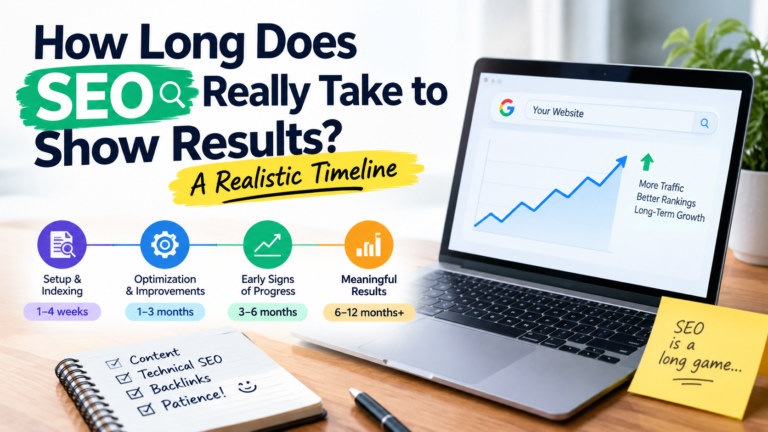
One of the most common questions we hear from new clients is some version of “when will I see results?” It’s a fair question, and unfortunately most answers online are either vague (“it depends”) or unrealistically optimistic (“30 days!”). Here’s an honest, month-by-month breakdown of what actually happens after SEO work begins, based on typical campaign patterns.
Why SEO Isn’t Instant (and Why That’s Actually a Good Sign)
Search engines need time to crawl your changes, evaluate them against ranking signals, and build enough confidence in your site’s authority and relevance to move it up in results. This isn’t arbitrary friction — it’s what makes organic rankings more stable and valuable than paid ads, which disappear the moment you stop paying. A ranking earned through genuine SEO work tends to hold far longer than a rented position at the top of a paid results page.
Month 1: Foundation and Technical Fixes
The first month is rarely about rankings at all — it’s about fixing what’s holding the site back. This typically includes resolving crawl errors, improving site speed, fixing broken internal links, ensuring proper mobile responsiveness, and setting up or cleaning up on-page elements like title tags and meta descriptions.
What you’ll likely see: Little to no visible ranking movement yet. Some sites see minor improvements in Google Search Console data (impressions, crawl stats) as technical issues get resolved, but this is foundation work, not results yet.
Month 2-3: Early Signals and Long-Tail Movement
Once technical foundations are solid and new or optimized content starts getting indexed, you typically begin seeing movement on longer-tail, lower-competition keywords first. These are easier for search engines to evaluate and rank quickly since there’s less competition to out-rank.
What you’ll likely see: Impressions in Search Console climbing, some new keywords appearing in positions 20-50, and occasionally a few easier long-tail terms breaking into the first page. This is genuine progress, even if it doesn’t feel dramatic yet.
Month 4-6: Meaningful Ranking Movement Begins
This is typically when clients start feeling like “something is happening.” Content published in months 1-2 has had time to be crawled, evaluated, and in many cases has started earning some natural backlinks or internal link equity as the site grows. Competitive keywords that were sitting on page 2-3 often start moving toward page 1 during this window.
What you’ll likely see: Consistent, if gradual, ranking improvements across a growing number of keywords, along with the first noticeable increase in organic traffic that’s large enough to show up clearly in analytics rather than just Search Console noise.
Month 6-12: Compounding Growth
This is where SEO’s compounding nature becomes obvious. Each new piece of well-optimized content adds to the site’s overall topical authority, internal linking opportunities increase, and existing content that’s been live for months continues climbing as it accumulates more trust signals. Link building efforts (if part of the strategy) also tend to show their full effect in this window, since earned links take time to be discovered, crawled, and factored into rankings.
What you’ll likely see: For a reasonably competitive niche, this is typically when a well-executed campaign starts delivering results that meaningfully move the business — consistent first-page rankings for target terms, steady month-over-month organic traffic growth, and increasingly, rankings for terms you didn’t specifically target but that are topically related to your core content.
Factors That Speed Up or Slow Down This Timeline
Domain age and existing authority. A brand-new domain with no history takes noticeably longer to earn search engine trust than an established domain with years of consistent, quality content — sometimes adding several months to the early stages of this timeline.
Competition level in your niche. Highly competitive niches (finance, legal, health) generally take longer to see first-page results than niches with less established competition, simply because you’re competing against sites with years of accumulated authority.
Content publishing consistency. Sites that publish consistently (whether weekly or monthly) tend to see faster, more compounding growth than sites that publish in occasional bursts, since search engines reward consistent signals of an actively maintained, relevant site.
Technical starting point. A site with significant technical issues (slow load times, poor mobile experience, broken structure) takes longer to see results simply because more foundational work is needed before content and links can have their full effect.
Why “Guaranteed Rankings in 30 Days” Claims Should Raise Concern
Legitimate SEO work operates within how search engines actually evaluate and trust websites — a process that inherently takes months, not days, especially for competitive terms. Any agency promising fast, guaranteed top rankings is either targeting extremely low-competition, low-value keywords to hit that promise technically, or using tactics that risk a penalty down the line. A realistic timeline, communicated honestly upfront, is a better sign of a legitimate strategy than an unrealistic promise.
Setting Realistic Expectations With Stakeholders
If you’re managing SEO expectations internally (for a boss, client, or business partner), the most useful thing you can do early on is track leading indicators — impressions, average position, and indexed pages — rather than only watching for final rankings and traffic. These metrics move earlier and give a genuine signal that the strategy is working, even before rankings and traffic catch up months later.
A Note on Algorithm Updates During Your Campaign
It’s common for at least one significant search algorithm update to occur somewhere during a 6-12 month SEO campaign, given how frequently major search engines adjust their ranking systems. A well-optimized site built on genuine quality and relevance typically weathers these updates better than sites relying on manipulative tactics, but short-term fluctuations around an update are normal and not necessarily a sign anything is wrong with your strategy.
Frequently Asked Questions
Can I speed up SEO results with a bigger budget? To a degree — a larger budget can support more content production and link building in parallel, but it can’t bypass the fundamental time search engines need to crawl, evaluate, and trust changes. There’s a practical floor on timeline regardless of spend.
Why did my rankings drop temporarily after a few months of progress? Temporary fluctuations are normal and often tied to broader search algorithm updates, competitor activity, or seasonal search behavior changes — a single dip isn’t usually cause for concern if the overall trend over several months remains upward.
Does SEO ever “finish,” or is it ongoing? SEO is generally an ongoing effort rather than a one-time project, since competitors continue publishing content and building links, and search engines periodically update how they evaluate quality and relevance.
Is local SEO faster than national SEO? Often yes, for businesses with a genuine local presence, since local search results factor in proximity and local relevance signals that reduce the pool of direct competition compared to ranking nationally.
For more on realistic SEO strategy and timelines, explore our SEO services or get in touch to discuss your specific site’s starting point.
External reference: Google’s own Search Central documentation{:target=”_blank” rel=”nofollow noopener”} on how indexing and ranking work.