Imagine spending hours writing a blog post, only to see it languish on page 10 of Google. You did the work, but no one visits. Why? You probably targeted the wrong terms.
Many website owners make the mistake of chasing high-volume, broad keywords. They want to rank for “shoes” or “marketing.” But here is the hard truth: you cannot win those battles if you are just starting out. You are competing against giants with billions of dollars and decades of authority.
The smart path to success lies in finding the gaps. You need a solid Keyword Research Guide: Find Low-Competition Keywords to level the playing field. Low-competition keywords are your secret weapon. They are the terms your competitors ignore, the specific questions people ask, and the niche topics that attract buyers ready to convert.
In this guide, you will learn exactly how to find these hidden gems. We will cover tools, techniques, and strategies to build a content plan that actually works.
If you are looking for professional help to build your online presence, exploring options with a trusted affordable digital marketing solutions provider can give you a significant head start.
What Are Low-Competition Keywords?
Before we dive into the “how,” we must understand the “what.”
Low-competition keywords are search terms that are relatively easy to rank for . They typically have a low keyword difficulty (KD) score. This means fewer websites are actively trying to rank for them .
These keywords often share specific traits:
-
Long-Tail Format: They are usually longer and more specific (3+ words) .
-
Lower Search Volume: They don’t get millions of searches per month, but the traffic they bring is highly targeted .
-
High Intent: The people using these terms often know what they want. They might be ready to buy or deeply research a specific problem .
For example, compare “furniture” (broad) to “walnut art deco furniture” (niche). The second term has less search volume, but it is much easier to rank for, and the visitor is far more likely to buy .
Focusing on these terms is like fishing with a spear instead of a net. You catch fewer fish, but the ones you catch are the exact fish you want.
Why You Need This Keyword Research Guide
You might wonder, “Why bother with small keywords? I want massive traffic.”
It is a fair question. However, targeting low-competition keywords is the foundation of long-term growth . Here is why this strategy matters:
-
Faster Wins: When you target terms with low difficulty, you can see results in weeks, not years. These quick wins boost your confidence and show you that your SEO efforts are working .
-
Build Authority: Every time you rank for a small term, you build credibility with Google. Over time, this “domain authority” allows you to target bigger, more competitive terms .
-
Cost-Effective: You don’t need to spend thousands on backlinks or ads. You win with better content and smart targeting .
-
Higher Conversion Rates: Niche keywords align perfectly with user intent. If someone searches for “best running shoes for marathon training,” they are much closer to a purchase than someone searching for “shoes” .
To scale these efforts effectively, you need a robust online presence. Understanding how to leverage platforms like linkz.media can help you connect your content strategy with broader brand visibility.
Step 1: Brainstorm Seed Keywords
Every great Keyword Research Guide: Find Low-Competition Keywords starts with a brainstorming session. You need “seed keywords” to plant in your research tools .
Think about your business from your customer’s perspective. What problems do they have? What questions do they ask?
-
List the core topics of your business.
-
Write down the products or services you offer.
-
Think about the solutions you provide.
For example, if you sell organic coffee, your seed keywords might be: “organic coffee,” “fair trade beans,” and “home brewing.”
Don’t overthink this step. Just get the basic ideas down on paper. You will refine them later.
Step 2: Use Free Tools to Expand Your List
Now, take those seed keywords and feed them into free tools. You don’t need expensive software to start finding gold.
Google Autocomplete and “People Also Ask”
Google itself is the best free keyword tool . Type your seed keyword into the Google search bar. Don’t hit enter. Look at the suggestions that drop down. These are real searches people are making right now .
After you search, scroll down. You will see two powerful sections:
-
People Also Ask: A box of questions related to your topic. Clicking on one generates even more questions .
-
Related Searches: At the very bottom of the page, Google lists other search terms people used. These are often long-tail, low-competition gold mines .
Google Trends
This tool shows you what is rising in popularity . Enter your seed keyword. Look at the “Related queries” section. You will see terms marked as “Breakout” or with a percentage increase. These are emerging topics that competitors haven’t spotted yet .
Google Search Console (GSC)
If you already have a website, GSC is your best friend . Log in and look at the “Performance” tab. Find queries where you rank between positions 10 and 30. These are keywords you are almost ranking for . With a little optimization, you can push them onto page one .
Step 3: Dive Into Niche Communities
Your target audience is talking about their problems every day. They just aren’t doing it on your website yet. They are on forums.
Reddit and Quora are incredible resources for this Keyword Research Guide: Find Low-Competition Keywords .
Go to Reddit and search for your topic. Find the subreddits (communities) related to your niche . Look at the questions people are asking. What specific words are they using?
You can even use a Google search operator to make this faster. Type this into Google:
site:reddit.com [your seed keyword]
This will show you every Reddit thread that mentions your term . The phrases you find here are often completely untapped by mainstream blogs .
For example, if you are in the fitness niche, you might find a user asking, “How do I avoid knee pain when running on concrete?” That long question is a perfect low-competition keyword for a blog post.
Step 4: Spy on Your Competitors (The Smart Way)
You don’t need to reinvent the wheel. Your competitors have already done a lot of the research for you.
Use a keyword tool (like SEMrush, Ahrefs, or Ubersuggest) and enter a competitor’s URL . Look at the keywords they rank for.
But here is the trick: don’t look at their top keywords. Look at the ones on page two or three . These are keywords where your competitor is weak. They have proven there is search demand, but they haven’t locked it down.
You can create better content and steal that traffic .
Step 5: Analyze the Metrics
Now you have a big list of potential keywords. It is time to separate the winners from the losers. You need to look at the data.
Most keyword tools provide two critical metrics :
-
Search Volume: How many people search for this term each month? Aim for a balance. If volume is zero, skip it. If it’s in the thousands, that is great, but check the competition. Often, a volume of 100 to 1,000 is a sweet spot for beginners .
-
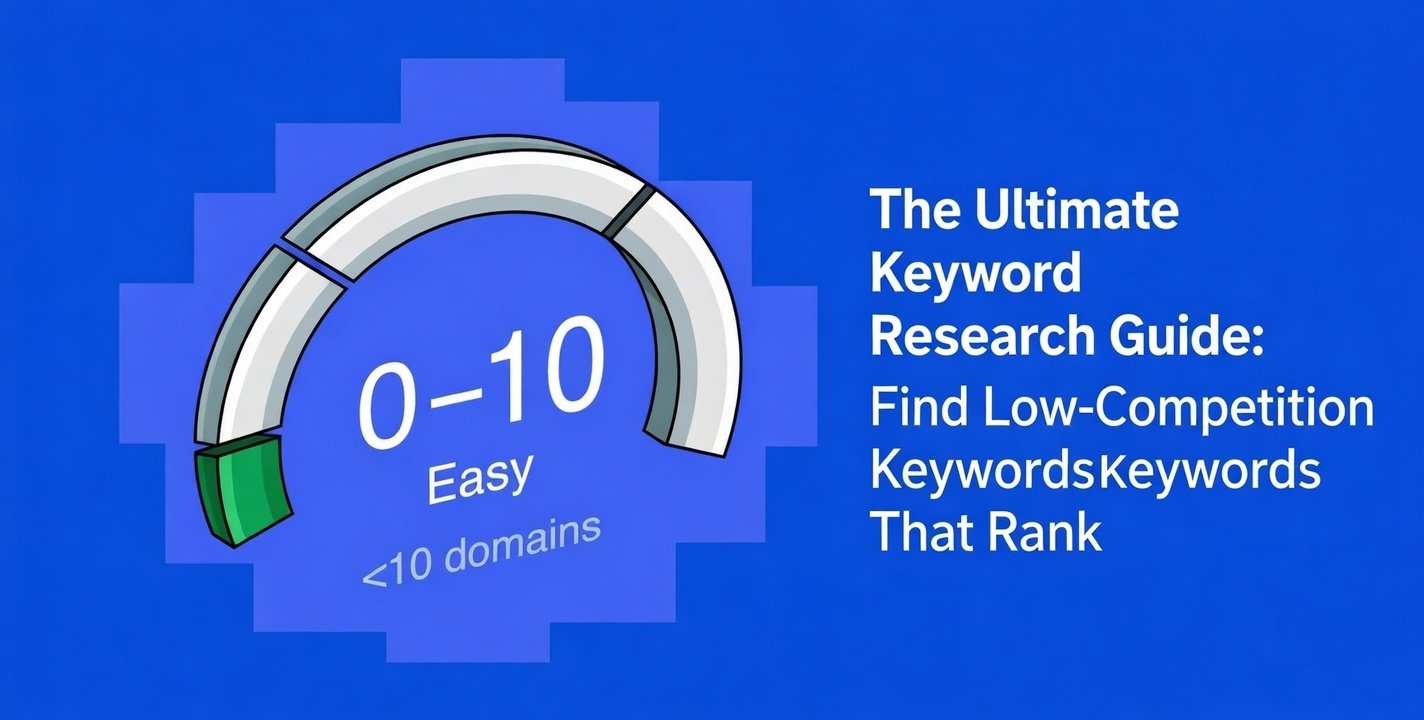
Keyword Difficulty (KD): This score (often 0-100) tells you how hard it is to rank . As a rule of thumb in this Keyword Research Guide: Find Low-Competition Keywords, look for a KD score under 30 . Some experts even suggest under 10 for brand new sites .
You are looking for the intersection of “decent volume” and “low difficulty.”
Step 6: Match Search Intent
This step is crucial. A keyword might look perfect on paper, but if you create the wrong type of content, you will never rank.
Search intent is the “why” behind the search . There are four main types:
-
Informational: The user wants to learn (e.g., “how to brew coffee”).
-
Commercial: The user wants to research before buying (e.g., “best coffee machines”).
-
Navigational: The user wants to find a specific site (e.g., “Starbucks menu”).
-
Transactional: The user wants to buy (e.g., “buy Arabica beans online”).
Look at the current Google results for your target keyword. If the top results are all blog posts, you need to write a blog post. If they are product pages, you need a product page . Google is telling you exactly what the searcher wants.
Step 7: Use AI to Supercharge Your Research
AI tools are changing the SEO game. They can analyze massive amounts of data in seconds .
You can use AI-powered SEO tools like SurferSEO or even ChatGPT (with careful prompting) to generate keyword ideas based on your seed terms .
However, be careful. General AI chatbots can “hallucinate” and give you keywords that don’t actually have search volume . Always verify AI suggestions with a dedicated keyword tool that provides real metrics like search volume and KD .
Once you have your keywords, you need a strong platform to publish your content. Utilizing services like premiumlinkpost.com can help ensure your well-researched content gets the authoritative backlinks it deserves.
Mistakes to Avoid in Your Keyword Research
Even with a great guide, it is easy to slip up. Avoid these common errors:
-
Chasing High Volume Only: A keyword with 10,000 searches and 90 KD is a trap. You will waste time and money .
-
Ignoring Low-Volume Terms: Don’t dismiss a keyword with 50 searches a month. If it is super specific, it might convert at 10%, which is better than 0.01% from a broad term .
-
Keyword Stuffing: Once you pick a keyword, use it naturally. Don’t force it into every sentence. Write for humans first .
-
Forgetting to Update Content: SEO isn’t “set it and forget it.” Revisit your old posts. Update them with new information to keep them ranking .
Summary
Finding the right keywords is the foundation of SEO success. By focusing on low-competition keywords, you can win traffic, build authority, and grow your business without fighting unwinnable battles. Remember the steps: brainstorm seeds, use free tools, check forums, analyze metrics, and respect search intent.
Now it is your turn. Start with one seed keyword today. Spend 30 minutes using the techniques in this Keyword Research Guide: Find Low-Competition Keywords. You will be amazed at the opportunities you find hiding in plain sight.
What is the most surprising “niche topic” you have found in your industry? Share it in the comments below!
Frequently Asked Questions
1. What is considered a “low” keyword difficulty score?
Generally, a score of 0-30 is considered low competition. For brand new websites, targeting scores under 15 or 20 is a safe bet .
2. Can I rank for low-competition keywords without backlinks?
Yes, often you can. Because these keywords have low competition, high-quality, well-written content that perfectly matches search intent is often enough to rank on page one .
3. Are long-tail keywords always low competition?
Not always, but very often they are. As you add more words to a query, the search becomes more specific, and fewer websites tend to target that exact phrase .
4. How many keywords should I target per blog post?
Focus on one primary keyword. Then, naturally include 3-5 secondary keywords (related terms) to give your post depth and context .
5. Is Google Keyword Planner free?
Yes, it is a free tool, but it is designed for Google Ads. It provides search volume data, but its competition metrics are geared towards paid ads, not organic SEO .
References
-
Backlinko: Industry-leading case studies on keyword research and the importance of search intent.
-
Surfer SEO: Detailed guides on keyword difficulty and SERP analysis for content optimization.
-
Writesonic: Practical strategies for using Google and Reddit to uncover hidden keyword opportunities.
-
Shopify Blog: E-commerce focused research on niche keywords and user intent for conversion.
-
Brafton: Comprehensive overviews of “easy-to-rank” keywords and common research mistakes.
-
SEOptimer: Actionable insights on using Google Search Console for “low hanging fruit” keyword identification.