How to Spot a PBN or Link Farm Before You Buy a Guest Post: 12 Red Flags I Check Every Time
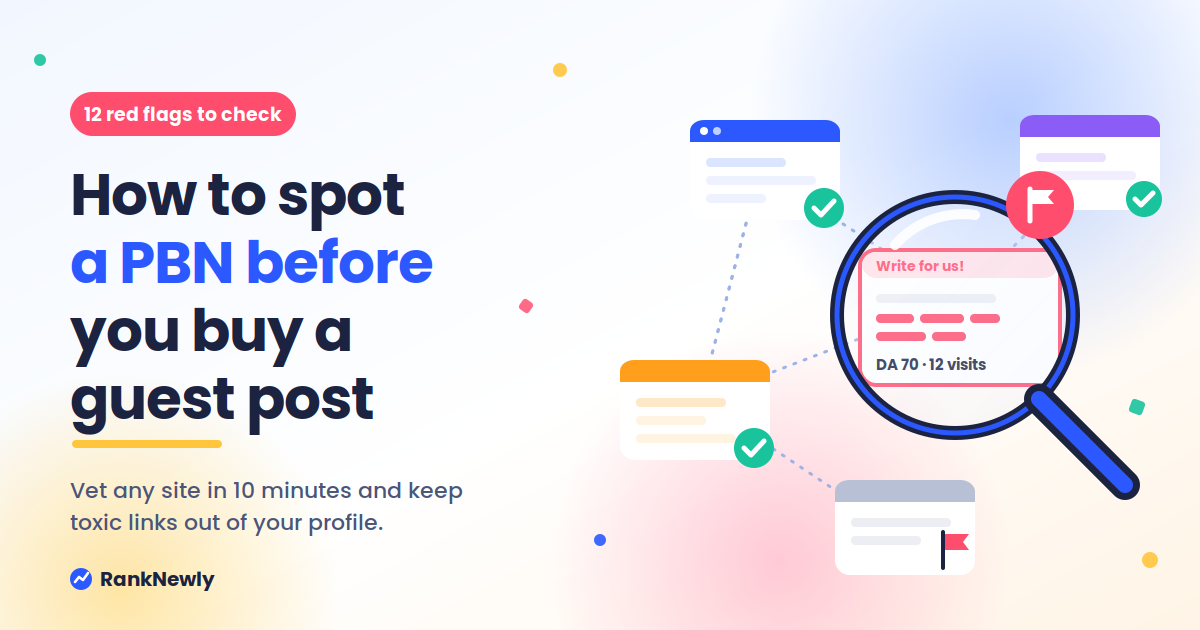
Buying a guest post can be one of the fastest ways to earn a strong, relevant backlink. It can also be one of the fastest ways to waste money. The difference usually comes down to one thing: whether the site you’re buying from is a real publication with real readers, or a private blog network (PBN) or link farm dressed up to look like one.
After reviewing thousands of publisher sites, I’ve found the warning signs are surprisingly consistent. Most bad sites fail at least three of the checks below within a few minutes. In this guide, I’ll walk you through the 12 red flags I check before approving any placement. If you’re new to buying links, our guide on how guest post marketplaces work explains the basics first.
What Is a PBN, and Why Is It Risky?
A private blog network is a group of websites built or bought mainly to pass link authority to other sites. Many are built on expired domains that still carry backlinks from their previous life. The content is thin, the audience is non-existent, and the real “product” is the outbound link.
A link farm is similar but less subtle: a site that publishes almost anything for a fee, with dozens of unrelated outbound links on every page.
Both carry real risk. Google’s spam policies specifically list link schemes, including buying or selling links that pass ranking credit and excessive link exchanges. Possible outcomes include:
- Links being quietly ignored, so you pay for zero value
- Algorithmic devaluation after a spam update
- In serious cases, a manual action against your site
The safest assumption is simple: a link from a site that exists only to sell links is worth little, and it might cost you.
The 12 Red Flags
1. Traffic Doesn’t Match the Authority Metrics
This is the first thing I check. A site with DA or DR 50+ but under 500 monthly organic visits is a major warning sign. Real publications that earn strong links almost always earn real traffic too. Inflated authority with no traffic usually means an expired domain or manipulated metrics.
Check: Compare Ahrefs DR or Moz DA with estimated organic traffic in Ahrefs, Semrush or Similarweb.
2. The Traffic Graph Looks Like a Cliff
Look at the organic traffic trend over the past two years. A sharp drop, especially around a Google core or spam update, suggests the site has already been hit. Buying a link there means tying your site to a domain Google has already flagged as low quality.
3. Traffic Comes From the Wrong Countries
An English-language site targeting the UK or US that gets most of its traffic from unrelated regions may be buying bot traffic to look healthy. Check the country breakdown in your SEO tool.
4. It Ranks for Nothing Relevant
Open the site’s organic keywords report. A real tech blog ranks for tech terms. A PBN often ranks for random, low-value phrases, or for nothing at all beyond its brand name.
5. “Write for Us” on Every Page, in Every Niche
A site that covers health, crypto, home improvement, gambling, pets and SaaS all at once, with a prominent “Write for Us” or “Submit Guest Post” banner, is selling links, not serving readers. Topical focus is one of the strongest signs of a real publication.
6. Outbound Links Overwhelm the Content
Skim five recent posts. If each one includes multiple commercial outbound links to unrelated businesses, the site is a link farm. Real publishers link out to sources and references, not to five casino and CBD sites in a 600-word post.
7. The Content Is Thin, Spun or Obviously Mass-Produced
Read a couple of articles properly. Warning signs include:
- Generic 500-word posts with no examples or original insight
- Awkward phrasing that suggests spinning or unedited AI output
- Dozens of posts published on the same day
- No images, or only stock images unrelated to the text
8. No Real Author, Brand or Contact Details
Genuine sites show who runs them. Check for real author bios, an About page with a real story, and a way to contact the editorial team. Fake names, recycled author photos and a Gmail address as the only contact are classic PBN traits.
9. The Domain History Doesn’t Add Up
Use the Wayback Machine to look at what the site used to be. If a domain was a dentist’s website in 2022 and is now a general “lifestyle and business” blog, it was likely bought as an expired domain for its backlinks. Our walkthrough on checking a domain’s history shows exactly how to do this in a couple of minutes.
10. Shared Footprints With Other Sites
PBN owners often reuse the same theme, hosting, analytics IDs, author names and even logo styles across their network. If you notice several sites on a vendor list that look almost identical, treat the whole batch with caution.
11. No Social or Community Presence
A real publication usually has at least some footprint beyond its own domain: social profiles with genuine engagement, mentions on other sites, or a newsletter. A site with zero presence anywhere else is more likely to be a link vehicle.
12. Prices and Promises That Sound Too Good
“DA 70 guest post for $15, permanent, dofollow, guaranteed indexed in 24 hours.” Real editorial placements on sites with genuine traffic rarely come that cheap. Very low prices across a long list of high-DA sites almost always signal PBN inventory.
Quick Reference: Healthy Site vs PBN
| Signal | Healthy publisher | Likely PBN or link farm |
|---|---|---|
| Organic traffic | Steady or growing | Tiny, or crashed after updates |
| Topic focus | One clear niche | Covers everything |
| Outbound links | Contextual, relevant | Many commercial, unrelated |
| Authors | Real, verifiable | Fake or missing |
| Domain history | Consistent | Changed niche or owner recently |
| Pricing | Reflects real audience | Suspiciously cheap |
My 10-Minute Vetting Checklist
When I’m short on time, I run through this sequence before approving any guest post:
- Compare DR or DA with organic traffic (2 minutes).
- Check the two-year traffic trend for sharp drops (1 minute).
- Scan the top 20 ranking keywords for relevance (1 minute).
- Read two recent posts and count outbound commercial links (3 minutes).
- Check the About page and author bios (1 minute).
- Look at the domain in the Wayback Machine (2 minutes).
If a site fails two or more of these steps, I move on. There are always better options.
What a Good Guest Post Placement Looks Like
Avoiding bad sites is only half the job. A strong placement should also:
- Sit on a site that is topically related to your business
- Appear in a genuinely useful article, not a thin “sponsored” filler post
- Use a natural anchor text, ideally your brand or a descriptive phrase rather than an exact-match keyword every time
- Link to a page that adds real value to the reader
If you want to dig deeper into anchor choices, our anchor text strategy guide covers how to keep your profile natural.
Why Relevance Now Beats Raw Authority
The industry has shifted. Search Engine Land has covered for years how Google increasingly evaluates links in context, and practitioners such as Neil Patel consistently stress topical relevance over raw domain metrics. A DR 35 site with real traffic in your exact niche often does more for your rankings than a DR 70 general blog that sells links to anyone.
There’s also a newer reason to care: AI-powered search features tend to cite trusted, well-known sources. Placements on real publications can help you appear there too, while PBN links offer nothing in that context.
How RankNewly Approaches Publisher Vetting
At RankNewly, we built our marketplace around exactly this problem. Every publisher listing is reviewed for real traffic, topical focus and editorial standards, and we don’t accept PBNs. The goal is full transparency, so you can see what you’re buying before you place an order. You can browse vetted publishers on our guest post marketplace.
Final Thoughts
Buying guest posts isn’t the problem. Buying them blindly is. Spend 10 minutes vetting each site, and you’ll avoid most toxic placements before they ever touch your link profile. Prioritise relevance, real traffic and genuine editorial quality, and your link-building budget will go much further. For ongoing industry news and algorithm updates, Search Engine Land remains one of the best resources to follow.
Frequently Asked Questions
Are all paid guest posts against Google’s guidelines? Google asks that paid links be marked with rel=”sponsored” or rel=”nofollow.” Many sites and buyers ignore this, so understand the risk and focus on genuinely editorial placements.
Can a PBN link still help rankings? Sometimes in the short term, but the risk of devaluation or penalties makes them a poor long-term investment.
What’s a safe minimum traffic level for a guest post site? There’s no fixed rule, but as a starting point, look for at least 1,000 to 2,000 monthly organic visits from relevant countries.
How can I check if my existing backlinks come from PBNs? Export your backlinks from Ahrefs or Semrush and run each referring domain through the same 12 checks above.