How to Increase Domain Authority and Traffic in 2026 (Without Chasing a Vanity Metric)
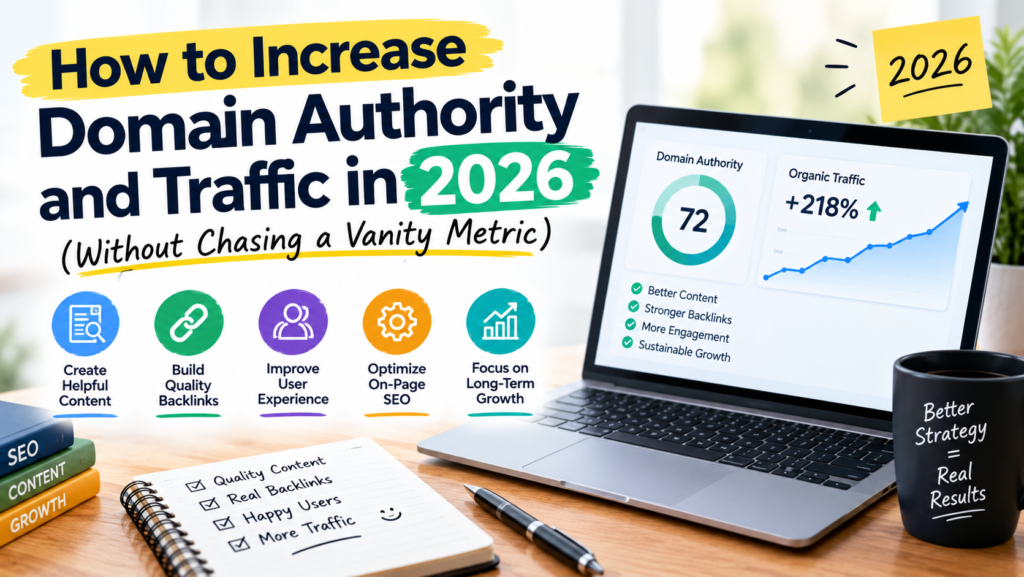
Domain Authority is a Moz metric, not a Google ranking factor — Google has said this outright more than once. And yet DA remains one of the most-searched SEO terms out there, mostly because it’s a useful shorthand for “how strong does this site look to an algorithm modeling authority.” The good news is that almost everything that raises DA in a genuine, lasting way is the same thing that raises real organic traffic. Chase the traffic, and DA tends to follow.
Why DA and Traffic Usually Move Together (But Not Always)
DA is calculated primarily from your backlink profile — the number and quality of unique linking root domains pointing at your site. Traffic depends on backlinks too, but also on matching search intent, technical health, and content depth. It’s entirely possible to raise DA with a burst of low-quality links and see zero traffic movement, which is exactly the trap a lot of sites fall into. Google’s own Search Central guidance on E-E-A-T makes clear that content quality and demonstrated expertise matter independently of raw link volume — the two need to be built together, not treated as substitutes for each other.
1. Fix Technical Health Before Anything Else
A site with slow load times, broken internal links, or pages blocked from indexing is fighting itself before a single new backlink even matters. Run a full crawl, fix broken links and redirect chains, and confirm your important pages are actually indexable — this is unglamorous work, but it’s also the fastest traffic win available on most sites, because you’re recovering value you already earned rather than building something new.
2. Build Topical Depth, Not Just Individual Pages
Search engines increasingly reward sites that demonstrate comprehensive coverage of a topic cluster rather than a single strong page surrounded by thin, unrelated content. If your target keyword is a lawsuit-response topic, for example, surrounding it with related content on adjacent legal questions — the kind of long-tail question list we track for keyword rank tracking clients — signals topical authority in a way one isolated article never can.
3. Earn Links Through Genuinely Link-Worthy Assets
Original research, free tools, and data-driven content consistently earn more organic, unsolicited backlinks than any outreach campaign built around asking for a favor. This doesn’t need to be complicated — even a simple industry survey with a clear, quotable stat can become the kind of source other writers link to for months or years after publication, compounding in a way paid placements never do.
4. Internal Linking Is Free Authority You’re Probably Wasting
PageRank flows through internal links just like external ones. A high-authority page that never links out to your newer, weaker content is hoarding value it could otherwise pass along. Auditing your internal link structure — making sure your best pages link down into the content you actually want to rank — is one of the highest-leverage, zero-cost changes available, and it pairs directly with the link building case studies we track for client sites, where internal restructuring alone has moved rankings without a single new external link.
5. Prioritize Relevance Over Raw Link Volume
A handful of links from sites genuinely relevant to your niche outperforms dozens of links from unrelated, high-DA sites bought purely for the metric. This is also the safer long-term strategy, since relevance is exactly what separates a natural link profile from one that reads as manipulated to Google’s spam systems.
6. Update and Consolidate Old Content Instead of Only Publishing New
Pages that haven’t been meaningfully updated in over a year are quietly losing ground to fresher competing content, even without any change on your end. Refreshing statistics, adding new sections, and consolidating several thin, overlapping pages into one comprehensive resource routinely produces faster traffic gains than publishing an equivalent number of brand-new pages. If your guest post marketplace listings or older service pages haven’t been touched in a while, that’s usually the first place worth auditing before writing anything new.
7. Diversify Your Referring Domains, Not Just Your Link Count
Ten links from ten different, relevant domains carry more weight than fifty links from the same five sites. Link diversity is one of the clearer signals separating a naturally grown authority profile from a manufactured one, and it’s worth tracking referring domain count specifically, not just total backlinks, when measuring progress month over month.
8. Don’t Neglect Anchor Text Diversity
A link profile dominated by exact-match keyword anchors looks manufactured to search engines and has been a common trigger for algorithmic devaluation for years. A healthy mix of branded anchors, naked URLs, generic phrases like “read more,” and only occasional exact-match keyword anchors reads as far more natural — and natural is what you actually want your profile to look like, regardless of how the links were acquired.
How Long Before You See Real Movement
DA updates on Moz’s own schedule (roughly monthly), but the underlying traffic and ranking improvements from technical fixes, content depth, and quality links typically take 8 to 16 weeks to fully show up in analytics, longer for highly competitive niches. Tracking leading indicators — indexation status, average position for target keywords, referring domain growth — gives a more honest read on progress than waiting for a single lagging metric to move.
Frequently Asked Questions
Should I try to buy Domain Authority directly?
No — DA itself isn’t purchasable in any legitimate sense, and services claiming to “boost DA” through link schemes typically use exactly the low-quality, high-risk tactics that put your traffic at risk without producing durable authority.
Does site age affect Domain Authority?
Indirectly. Older sites have simply had more time to accumulate a natural link profile, but age alone isn’t scored — a newer site with strong topical depth and quality backlinks can and does outrank older, neglected domains.
Can losing backlinks lower my Domain Authority even if I haven’t done anything wrong?
Yes — link decay is normal as other sites redesign, remove old content, or shut down entirely. This is exactly why ongoing link acquisition matters even for an already-established site; standing still while your existing links naturally erode is effectively losing ground.
The Bottom Line
Chasing Domain Authority as a standalone number is a losing game — it’s a lagging indicator of the things that actually matter: technical health, topical depth, and a relevant, diverse link profile. Build those three consistently, and both DA and real organic traffic tend to rise together, which is the only combination that actually matters for a business.